
How to Learn Arabic: A Step-by-Step Guide for Beginners
Arabic is one of the most widely spoken languages in the world, with over 400 million speakers across the Middle East and North Africa (MENA). It is also the language of the Quran, and has a rich cultural and historical significance. If you’re interested in learning Arabic, whether for travel, business, or personal enrichment, this article will guide you through the steps to start your journey.
ش Understand the Structure of the Arabic Language
Before diving into learning, it’s important to understand the basic structure of the Arabic language. Arabic is a Semitic language, which means it has a different structure and grammar system compared to Indo-European languages like English. Some key aspects to note:
- Alphabet and Script: Arabic is written from right to left, and it uses its own alphabet, consisting of 28 letters. The letters change their form depending on whether they appear at the beginning, middle, or end of a word.
- Vowel System: Unlike English, Arabic uses a system of short vowels (which are typically not written in formal texts) and long vowels. The presence or absence of vowels can change the meaning of a word significantly.
- Root System: Arabic words are often built around three-letter roots. The root system is essential for understanding how words are derived and related to one another.
Learn the Arabic Alphabet
The first step in learning Arabic is to master the Arabic alphabet. Although it may seem intimidating at first, with practice, you’ll become more comfortable with it. The alphabet is phonetic, so each letter corresponds to a particular sound.
:Here are a few tips for learning the alphabet
- Start with the letters: Focus on learning the shapes and sounds of the Arabic letters. There are some letters in Arabic that don’t have direct equivalents in English, such as “ع” (Ain) or “ق” (Qaf).
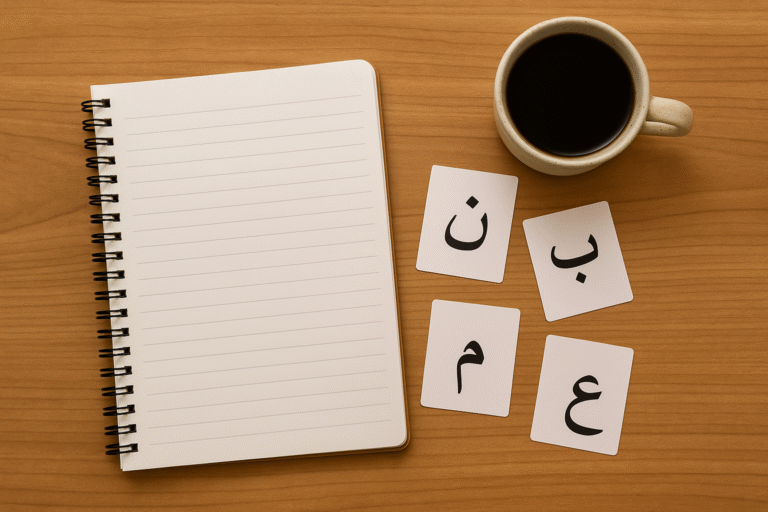
- Practice writing: Arabic script requires practice, as the shape of each letter changes based on its position in the word (beginning, middle, or end). Begin by writing each letter repeatedly to get familiar with its form.
- Use Flashcards: Flashcards are a great way to reinforce memory. Write the Arabic letter on one side and its pronunciation on the other side.
3. Focus on Pronunciation
Arabic has many sounds that do not exist in English, and correct pronunciation is key to being understood. For instance, Arabic has sounds like “خ” (Kha), “ص” (Saad), and “غ” (Ghayn), which may take some time to master for non-native speakers.
:Tips for mastering pronunciation
- Listen to native speakers: Regularly listening to Arabic audio, such as podcasts, songs, or news broadcasts, will help you familiarize yourself with the natural flow of the language.
- Use language apps: Language learning apps like Duolingo, Babbel, or Memrise can help you practice pronunciation with the help of audio from native speakers.
- Repeat after speakers: Mimicking native speakers is one of the most effective ways to learn accurate pronunciation.
4. Learn Basic Vocabulary and Phrases
Building your vocabulary is an essential step in any language-learning process. Start with the most common words and phrases used in everyday conversation. Learning common greetings, numbers, and expressions will allow you to start forming basic sentences.
:Examples of basic Arabic phrases
- Hello: مرحبًا (Marhaban)
- How are you? كيف حالك؟ (Kayfa halak? [to a male] / Kayfa halik? [to a female])
- Thank you: شكراً (Shukran)
- Goodbye: وداعاً (Wada’an)
- Yes: نعم (Na’am)
- No: لا (La)
As you progress, you can gradually add more words to your vocabulary, such as words for food, travel, and common activities.
5. Learn Arabic Grammar Basics
Arabic grammar can seem complex, but starting with the basics will help you build a solid foundation. Focus on the following key elements:
- Nouns and Pronouns: Arabic nouns have gender (masculine and feminine), and pronouns change depending on the gender and number (singular, plural, dual). For example, “he” is “هو” (huwa) and “she” is “هي” (hiya).
- Verb Conjugation: Arabic verbs are conjugated according to tense and subject. The three main tenses are the present, past, and future. For example, the verb “to write” (كتب) changes in the present tense to “يكتب” (yaktub) for “he writes,” and “تكتب” (taktub) for “she writes.”
- Sentence Structure: The typical word order in Arabic is Verb-Subject-Object (VSO), but in spoken Arabic, Subject-Verb-Object (SVO) is often used.
- Definiteness: In Arabic, the definite article “the” is attached to the noun as a prefix. For example, “book” is “كتاب” (kitaab), and “the book” is “الكتاب” (al-kitaab).
6.Choose Between Modern Standard Arabic (MSA) and Dialects.
Arabic has many regional dialects that can differ significantly from one another. These dialects are primarily spoken in daily life, while Modern Standard Arabic (MSA) is the formal language used in writing, media, literature, and official settings.
:Key points
- Modern Standard Arabic (MSA): If you’re aiming to read newspapers, literature, or understand the news, you should focus on MSA. It’s used throughout the Arab world, but it can sound formal and may not always be understood in casual conversation.
- Dialects: Each Arab country (or even region within a country) has its own dialect, with differences in vocabulary, pronunciation, and grammar. For example, the dialect spoken in Egypt (Egyptian Arabic) is different from that spoken in Lebanon (Levantine Arabic), or the dialect used in the Gulf region (Gulf Arabic).
Choosing which form of Arabic to focus on depends on your goals. If you’re learning Arabic for travel or to communicate with specific people, focusing on the dialect of that region may be more practical. Otherwise, starting with MSA can give you a broad foundation.
7. Immerse Yourself in the Language
One of the best ways to learn Arabic quickly is through immersion. Surround yourself with the language as much as possible:
- Watch Arabic TV shows and movies with subtitles to help improve your listening skills and get familiar with different dialects.
- Practice speaking: Try finding a language exchange partner or a tutor online. Platforms like iTalki and HelloTalk are great for connecting with native speakers.
- Read Arabic books or articles on topics that interest you. Start with simple children’s books or news articles, and gradually move on to more complex materials.
8. Practice Consistently
Like any language, consistency is key. Practice a little every day, even if it’s just for 10-15 minutes. Over time, your vocabulary, grammar, and pronunciation will improve. Keep a notebook to write down new words and phrases, and review them regularly.
Final Thoughts
Learning Arabic is a rewarding and intellectually stimulating process, but it requires patience, practice, and dedication. Whether you’re motivated by a desire to connect with Arabic speakers, understand the culture, or access a wealth of literature and knowledge, the journey is well worth the effort. By taking a structured approach, practicing consistently, and immersing yourself in the language, you’ll make steady progress and enjoy the process of mastering this beautiful and rich language.



The Best teacher to learn English
Good
Awesome https://t.ly/tndaA
Very good https://is.gd/N1ikS2
Good https://is.gd/N1ikS2
Very good
https://shorturl.fm/AmNmP
https://shorturl.fm/eVwLu